How to Do a Time Audit to Be More Productive: A Step-by-Step Guide to Spotting Inefficiencies
Learn how to do a time audit step by step to identify inefficiencies in your time management, boost productivity, and balance multiple jobs with concrete examples.
If you juggle multiple jobs, projects, or responsibilities, it’s easy to feel like time slips away without achieving what truly matters. A time audit is the most effective tool to uncover where you waste valuable hours, which tasks drain your energy without adding value, and how to reorganize your day for maximum productivity. Unlike generic methods, a time audit provides real data about your behavior, not assumptions. In this guide, you’ll learn how to do a time audit step by step, with concrete examples and techniques to apply it when managing multiple jobs, clients, or projects.

What Is a Time Audit and Why Is It Key for Productivity?
A time audit is a detailed analysis of how you spend your time over a specific period (typically a week). It’s not about timing every second but identifying patterns: which activities consume the most time, which are repetitive but unnecessary, and what interruptions pull you away from your goals. The difference between a time audit and other time management techniques is that this method is based on real data, not estimates or ideal to-do lists.
For those managing multiple jobs (freelancers, entrepreneurs, employees with side projects), a time audit is especially useful because it reveals:
- Invisible overlaps: Hours spent on one job when you should be working on another, or tasks that repeat across projects without need.
- Dead time between transitions: Minutes lost when switching contexts between clients, tools, or types of work.
- Low-value tasks: Activities that consume time but don’t generate income, learning, or real progress (e.g., checking email every 10 minutes).
- Energy leaks: Times of day when you’re less productive (e.g., after lunch) that you could use for mechanical tasks instead of creative ones.
A time audit doesn’t judge how you spend your time—it just shows you the reality: what you think you do rarely matches what you actually do.
How to Do a Time Audit Step by Step: A Practical Method
1. Define the Analysis Period (and Why a Week Is Ideal)
The first step in how to do a time audit is choosing a representative period. A week is the standard because it includes natural variations (weekdays vs. weekends, recurring meetings, unexpected events). If you work on projects, pick a typical week—not one with tight deadlines or vacations. Example: If you’re a freelance designer with three clients, track a week with normal deliveries, not one with an urgent project that distorts your habits.
2. Choose Your Tracking Tool (and Why Paper Might Be Better Than an App)
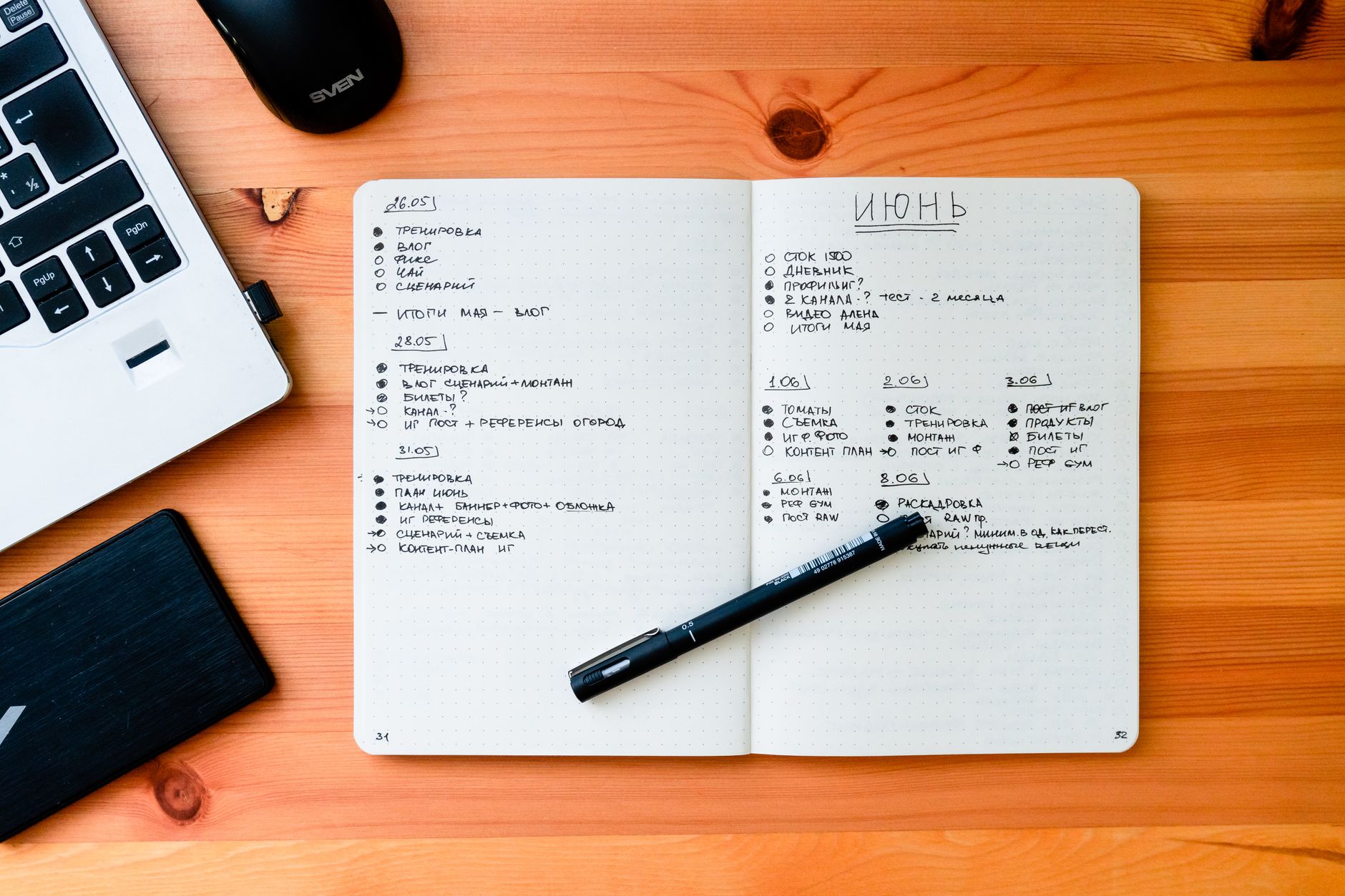
You can track your time with digital tools (like Toggl, Clockify, or even a spreadsheet) or analog methods (a notebook or printed templates). The key is that it’s easy and quick to use, so you don’t quit after two days. Advantages of paper:
- It forces you to be aware of each activity (writing by hand slows you down and makes you reflect).
- It avoids distractions (no notifications or temptation to check email while tracking).
- It’s more flexible for noting unexpected events or context switches (e.g., «Meeting with Client A ran 20 minutes over due to a technical issue»).
If you prefer digital, use an app with customizable categories to group tasks by job, activity type (meetings, execution, administration), or priority. Example structure:
- Job 1 (Client X): Logo design (execution), brief review (meeting), invoice submission (administration).
- Job 2 (Personal Project): Competitor research (learning), proposal writing (creation).
- Personal: Shopping, family calls, exercise.
3. Record Every Activity (With These Key Details)
For your time audit to be useful, each entry should include:
- Start and end time: Be precise (e.g., 9:15–10:03, not «morning»).
- Task description: Be specific (e.g., «Review Client B’s feedback in Figma» instead of «Work on client»).
- Context: Where were you? With whom? What tool did you use? (e.g., «At home, alone, using Slack and Notion»).
- Energy level: From 1 to 5 (1 = exhausted, 5 = energized). This helps identify your peak hours and which tasks you should do during them.
- Interruptions: Note if something distracted you (e.g., «Paused to reply to a WhatsApp message»).
Real example of tracking:
- 9:00–9:30: Email review (Job 1, Client A), energy 4, interruption: non-urgent vendor call.
- 9:30–10:15: Report writing (Job 2, Internal Project), energy 5, no interruptions.
- 10:15–10:25: Coffee break (Personal), energy 3.
- 10:25–11:00: Team meeting (Job 1, Client B), energy 2, interruption: colleague’s question about another project.
4. Analyze the Data: How to Spot Inefficiencies
Once you’ve tracked your week, it’s time to interpret the data. Look for these patterns:
Identify activities that repeat and don’t add value. Common examples:
- Checking email every hour (instead of 2–3 times a day in blocks).
- Attending meetings without a clear agenda or where you’re not actively needed.
- Administrative tasks you could automate or delegate (e.g., manually generating invoices).
Every time you switch tasks or jobs, you lose 10–20 minutes regaining focus. In your log, look for:
- Jumps between clients or projects in less than an hour (e.g., working on Client A, then Client B, then back to A in the same morning).
- Mixed tasks (e.g., replying to emails for Job 1 while writing a report for Job 2).
If you tracked your energy levels, compare which tasks you did during your peak hours (energy 4–5) and which during low-energy hours (energy 1–2). Example: If your energy is high in the morning but you use it for checking emails (a mechanical task), you’re wasting your best time for creative or strategic work.
List the 5 tasks that consumed the most time and ask: Did this time translate into tangible results (income, learning, project progress)? If the answer is no, that task is a candidate for elimination, delegation, or optimization. Example: A freelancer discovered they spent 8 hours a week on «market research» for a personal project, but that research didn’t lead to concrete decisions. They reduced it to 2 hours and used the remaining 6 for execution.
How to Act After the Time Audit: Strategies to Optimize Your Time
1. Group Tasks by Type and Context (Batching)
Batching involves grouping similar tasks to reduce context switching. Practical examples:
- Administrative tasks: Dedicate a 2-hour block per week to invoices, emails, and paperwork (instead of doing it in spare moments).
- Meetings: Group all meetings for the same client or project into one day (e.g., all Client A meetings on Tuesday mornings).
- Creative tasks: If you work on multiple projects, assign specific days or blocks for each (e.g., Monday and Wednesday for Job 1, Tuesday and Thursday for Job 2).
2. Eliminate, Delegate, or Automate
Apply the 3 D’s rule to tasks you identified as inefficient:
- Eliminate: Tasks that don’t add value (e.g., attending meetings without an agenda, checking social media for «inspiration»).
- Delegate: Tasks others can do (e.g., hiring a virtual assistant to manage emails, using templates for invoices).
- Automate: Repetitive tasks (e.g., using tools like Zapier to send automatic reminders, or email templates for frequent responses).
3. Use Your Peak Hours for What Matters
If your time audit revealed you’re most productive in the morning, reserve that time for tasks requiring deep focus (e.g., writing, designing, analyzing data). Save mechanical tasks (emails, calls, administration) for your low-energy hours. Example: A developer found their energy was highest from 8:00 AM to 12:00 PM, so they blocked those hours for coding and left afternoons for meetings and code reviews.
4. Set Boundaries for Interruptions
Interruptions are the biggest enemy of productivity, especially when managing multiple jobs. Strategies to reduce them:
- Silent blocks: Communicate to your team or clients that you won’t be available during certain hours (e.g., «I don’t respond to messages on Wednesdays from 9:00 AM to 12:00 PM»).
- Airplane mode: Turn off notifications for non-essential apps during deep work blocks.
- 2-minute rule: If an interruption takes less than 2 minutes (e.g., replying to a quick message), do it immediately. If not, note it for later.
Real Example: How a Freelancer Optimized Their Time with a Time Audit
Laura is a freelance graphic designer with three regular clients and a personal project (an online course). After doing a time audit for a week, she discovered:
- She spent 12 hours a week checking emails (3 hours per client + 3 for her personal project).
- She switched contexts 15 times a day (from one client to another, or from design to administration).
- She used her peak hours (mornings) for mechanical tasks (meetings, emails), while trying to design in the afternoons (low energy), which frustrated her.
With this data, Laura made the following changes:
- Email batching: Reduced email checks to 2 one-hour blocks per day (morning and afternoon), using templates for frequent responses.
- Client-specific days: Assigned specific days for each client (Monday and Thursday for Client A, Tuesday and Friday for Client B, Wednesday for Client C and her personal project).
- Peak hours for design: Reserved mornings for creative work and left afternoons for meetings and administration.
- Automation: Used tools like Canva to generate automatic invoices and Zapier to send client reminders.
Result: In a month, Laura reclaimed 8 hours a week (a full workday) and reduced stress by avoiding constant context switching. Plus, by using her peak hours for design, she improved her work quality and was able to take on a fourth client without increasing her working hours.
Tools to Maintain Control After the Time Audit
A time audit is useless if you don’t sustain the changes. These tools will help you maintain habits and avoid falling back into old patterns:
- Time-blocking calendars: Use Google Calendar or Outlook to reserve blocks of time for each type of task (e.g., «Client A Design – 9:00 AM–12:00 PM»).
- Time-tracking apps: Tools like Toggl or Clockify let you log time in real time and generate weekly reports to spot deviations.
- Context-based to-do lists: Group tasks by type (e.g., «Emails», «Meetings», «Design») to avoid unnecessary jumps between activities.
- Visual reminders: Use sticky notes or wallpapers with your top 3 priorities for the day to stay focused.
How to Apply What You’ve Learned with Foco
Once you’ve identified your inefficiencies with the time audit, you’ll need a tool to help you organize multiple jobs without losing control. Foco is an app designed to manage tasks from various projects in one place, ideal for those like Laura who need visibility and focus.
For example, you can create a work (container) for each client or project, assigning them distinct colors. In Panorama mode, you’ll see all your tasks together, each with its work’s color, helping you spot overlaps or time imbalances. If you need to focus on one project, switch to Focus mode: the dashboard will filter and show only tasks for that work, eliminating distractions.
The List, Kanban, and Calendar views let you organize tasks based on your needs. For instance, if your time audit revealed you waste time switching contexts, use the Kanban view to group tasks by stage (e.g., «To Do», «In Progress», «Done») and drag them as you progress. If you prefer planning by time blocks, the Calendar view shows your tasks alongside external events (like meetings synced from Google Calendar), so you can assign your peak hours to what matters most.
Additionally, features like voice capture or Ráfaga (for dictating multiple tasks in a row) help you log unexpected tasks or ideas without breaking your workflow. If you work with teams, collaboration lets you assign tasks to other members and share public links for specific tasks without granting access to the rest of your organization.
The goal isn’t just to do a time audit but to sustain the changes in your daily routine. With a tool like Foco, you can apply what you’ve learned in a practical way: group tasks by context, prioritize during your peak hours, and keep control of multiple jobs without getting lost in the chaos.
Try Foco
Every task from every job in one place. Free to start.