Ivy Lee Method for Multiple Jobs: How to Prioritize Without Drowning in Tasks
Learn the Ivy Lee method for managing multiple jobs: concrete steps, real examples, and how to apply it today to avoid task overload.
Managing multiple jobs at once—whether as a freelancer, entrepreneur, or professional juggling several projects—can feel like trying to drink from a firehose. Tasks pile up, deadlines overlap, and the sense of always running without making progress becomes exhausting. The Ivy Lee method for multiple jobs is a century-old technique that promises to cut through the chaos with a minimalist approach: fewer decisions, more action. But does it really work when you have five clients, three personal projects, and an endless to-do list? In this guide, we break down the method step by step, with concrete examples to adapt it to environments with multiple responsibilities, and show you how to apply it today to regain control.

What Is the Ivy Lee Method (and Why It Works for Multiple Jobs)
The Ivy Lee method was created in 1918 by productivity consultant Charles M. Schwab, president of Bethlehem Steel Corporation, who sought a way to increase his executives' efficiency. Schwab hired Ivy Lee, a pioneer in public relations, and asked him to design a simple yet effective system. Lee’s solution was so straightforward that Schwab paid him $25,000 at the time (equivalent to over $400,000 today) for it. The premise is simple: at the end of each day, you choose only six tasks for the next day, order them by priority, and focus on them one at a time, without distractions. No endless lists or multitasking: just six tasks, in order, until they’re done.
Why does this method work, especially when managing multiple jobs? The key lies in two psychological principles:
- Reduction of decision fatigue: Every morning, instead of wasting time deciding what to do, you already have a predefined, ordered list. This eliminates analysis paralysis, a common problem when tasks from different projects compete for your attention.
- Focus on what’s important, not what’s urgent: By limiting yourself to six tasks, you’re forced to prioritize what truly adds value, rather than reacting to what shouts the loudest (like that email from a client that can wait).
- Visible progress: Completing tasks in order gives you a tangible sense of progress, which is crucial when working on multiple fronts and progress can feel diffuse.
However, the original Ivy Lee method was designed for executives with a single job. To adapt it to multiple jobs, some adjustments are necessary, as we’ll see next.
How to Apply the Ivy Lee Method for Multiple Jobs: Step by Step
1. Gather All Your Tasks in One Place (No Filtering)
The first step is centralization. If your tasks are scattered across emails, sticky notes, Slack messages, or your head, the Ivy Lee method won’t work. You need a master list where you dump everything pending, regardless of which job it comes from. For example:

- Project A (client): Write progress report (due: Friday).
- Project B (company): Review landing page design (deadline: Wednesday).
- Personal project: Write blog article (no deadline).
- Home: Call plumber for water leak (urgent).
- Client C: Send overdue invoice.
- Project A: Prepare team meeting (tomorrow at 10:00 AM).
This master list must include tasks from all your jobs, without exceptions. If a task isn’t here, it doesn’t exist for the Ivy Lee method.
2. Assign a 'Job' to Each Task (So You Don’t Lose Context)
When managing multiple jobs, an isolated task loses meaning. For example, "Write report" could refer to three different projects. To avoid confusion, label each task with its context (the job it belongs to). This helps you:
- Avoid mentally mixing tasks from different projects (e.g., don’t think about Client A’s report while working on Client B’s design).
- Prioritize with criteria: if a job has tighter deadlines or greater impact, its tasks will rise to the top of the list.
- Switch contexts with less friction: when you finish a task from one job, you know exactly what’s next in that same area.
In the example above, you could add the context like this:
- [Project A] Write progress report (due: Friday).
- [Project B] Review landing page design (deadline: Wednesday).
- [Personal blog] Write article (no deadline).
- [Home] Call plumber (urgent).
3. Choose the 6 Most Important Tasks (and Discard the Rest)
Here’s the core of the Ivy Lee method for multiple jobs: selecting only six tasks for the next day. But how do you decide which ones? Use these criteria, in this order:
- Imminent deadlines: Tasks due today or tomorrow take absolute priority. Example: "[Project A] Prepare team meeting (tomorrow at 10:00 AM)".
- High impact: Tasks that generate income, prevent losses, or unblock others’ work. Example: "[Client C] Send overdue invoice" (without this, you don’t get paid).
- Dependencies: Tasks that, if not done today, will delay others. Example: "[Project B] Review landing page design" (the designer can’t move forward without your feedback).
- Real urgency: Tasks that, if not done today, will cause problems. Example: "[Home] Call plumber" (the water leak could worsen).
- Long-term importance: Tasks that aren’t urgent but are key to your goals. Example: "[Personal blog] Write article" (if you want to grow your audience).
In the example, the six selected tasks could be:
- 1. [Client C] Send overdue invoice.
- 2. [Project A] Prepare team meeting (tomorrow at 10:00 AM).
- 3. [Home] Call plumber (urgent).
- 4. [Project B] Review landing page design (deadline: Wednesday).
- 5. [Project A] Write progress report (due: Friday).
- 6. [Personal blog] Write article (no deadline).
What about tasks that don’t make the six? Leave them in the master list for the next day. If a task isn’t important enough to be in the top six, it doesn’t deserve your time today. This is hard at first—especially if you’re afraid of forgetting something—but it’s liberating: it forces you to trust that if a task is truly critical, it will appear on the next day’s list.
4. Order the 6 Tasks by Priority (and Don’t Change Them)
Once selected, order them from most to least important. This order is sacred: don’t modify it the next day, no matter how tempting a task may seem. The first task on the list is your only goal until it’s done. Only then do you move to the second, and so on. Example order for the next day:
- 1. [Client C] Send overdue invoice.
- 2. [Project A] Prepare team meeting (tomorrow at 10:00 AM).
- 3. [Home] Call plumber (urgent).
- 4. [Project B] Review landing page design (deadline: Wednesday).
- 5. [Project A] Write progress report (due: Friday).
- 6. [Personal blog] Write article (no deadline).
If you don’t complete all six by the end of the day, the pending tasks return to the master list for the next day. Don’t automatically carry them over: evaluate whether they’re still a priority.
5. Work on One Task at a Time (No Exceptions)
The Ivy Lee method requires radical single-tasking. This means:
- Don’t start task 2 until task 1 is done, even if task 2 is easier or more fun.
- Don’t check emails, messages, or social media until the current task is finished.
- If a new urgent task arises during the day, don’t add it to the list. Write it down in the master list and evaluate it the next day.
To avoid distractions, use techniques like:
- Time blocking: Assign a realistic time block to each task (e.g., 1 hour to prepare the meeting, 30 minutes to call the plumber).
- Airplane mode: If working digitally, turn on airplane mode or use apps to block distractions during the time block.
- 2-minute rule: If an interruption takes less than 2 minutes (e.g., replying to a quick message), do it and return to the task. If it takes longer, write it down for later.
6. Review and Repeat at the End of the Day
At the end of the day, do a quick review:
- Mark completed tasks (this gives you a sense of accomplishment).
- Note which tasks are pending and why (were there interruptions? Did you underestimate the time?).
- Update the master list with new tasks that arose during the day.
- Select the 6 tasks for the next day, following the same criteria.
This step is crucial: it allows you to close the day with clarity and start the next one with a defined plan, without the anxiety of the unknown.
Common Mistakes When Using the Ivy Lee Method with Multiple Jobs (and How to Avoid Them)
The Ivy Lee method is simple, but not easy. These are the most common mistakes when applying it to multiple jobs, along with practical solutions:

Mistake 1: Choosing Tasks from Only One Job
Problem: If you prioritize tasks from only one job every day (e.g., the highest-paying client or the project you like most), the others fall behind. Solution: Use the balance rule: in your list of six tasks, include at least one from each job with deadlines or dependencies. For example, if you have three active jobs, your six tasks could be: 2 from Job A, 2 from Job B, 1 from Job C, and 1 personal. Adjust the numbers based on each job’s urgency.
Mistake 2: Including Tasks That Are Too Large
Problem: A task like "[Project A] Develop new feature" could take days. If you include it in your list of six, you likely won’t finish it and will feel frustrated. Solution: Break large tasks into subtasks that you can complete in a time block (maximum 2-3 hours). For example:
- [Project A] Define requirements for the new feature (1 hour).
- [Project A] Create wireframe for the main screen (2 hours).
- [Project A] Review wireframe with the team (30 minutes).
Mistake 3: Ignoring Small but Critical Tasks
Problem: Tasks like "Send invoice," "Confirm meeting," or "Reply to supplier email" are often postponed because they don’t seem important, but they can cause problems if they pile up. Solution: Reserve a spot in your list for these tasks. For example, if one of your six tasks is "[Administrative] Manage invoices and pending emails," dedicate 30 minutes a day to closing these loose ends. That way, they don’t become a snowball.
Mistake 4: Not Adjusting the List During the Day
Problem: If a task becomes irrelevant (e.g., a client cancels a meeting) or an emergency arises (e.g., a server goes down), sticking to the list rigidly can be counterproductive. Solution: Allow yourself to adjust the list once a day, preferably at midday. Check if any task has lost priority or if something new needs to be added to the six. But don’t do this on the fly: note the changes and apply them in the evening review.
Real Example: A Day with the Ivy Lee Method for Multiple Jobs
To illustrate how the method works in practice, here’s a real example of a day in the life of Lucía, a freelance designer working with three clients and a personal project (an online course).

Lucía’s Master List (Before Prioritizing)
- [Client A] Design logo for summer campaign (due: Friday).
- [Client B] Review wireframe feedback (deadline: today).
- [Client C] Send proposal for new project (no deadline).
- [Online course] Record lesson 3 (no deadline).
- [Administrative] Send invoice to Client A (overdue).
- [Administrative] Reply to hosting provider email (urgent).
- [Home] Buy materials to repair shelf (no deadline).
- [Client A] Prepare follow-up meeting (tomorrow at 11:00 AM).
- [Client B] Fix errors in previous design (deadline: Thursday).
The 6 Tasks Selected for the Next Day
- 1. [Administrative] Send invoice to Client A (overdue).
- 2. [Client B] Review wireframe feedback (deadline: today).
- 3. [Administrative] Reply to hosting provider email (urgent).
- 4. [Client A] Prepare follow-up meeting (tomorrow at 11:00 AM).
- 5. [Client B] Fix errors in previous design (deadline: Thursday).
- 6. [Client A] Design logo for summer campaign (due: Friday).
How the Day Unfolded
- 8:30 - 9:00 AM: [Administrative] Send invoice to Client A. Lucía does this first to avoid payment delays. She includes a polite note reminding them of the overdue deadline.
- 9:00 - 10:30 AM: [Client B] Review wireframe feedback. She realizes the client has changed some requirements, so she adjusts the design and sends an updated version.
- 10:30 - 11:00 AM: [Administrative] Reply to hosting provider email. The hosting is raising prices, so Lucía negotiates an extension of the current discount.
- 11:00 AM - 12:30 PM: [Client A] Prepare follow-up meeting. She reviews the project’s progress, prepares a presentation with screenshots, and notes questions for the client.
- 12:30 - 2:00 PM: Lunch and break. Lucía avoids checking emails or messages to maintain her focus.
- 2:00 - 3:30 PM: [Client B] Fix errors in previous design. She finishes the corrections and sends them to the client for approval.
- 3:30 - 5:00 PM: [Client A] Design logo for summer campaign. She creates three logo proposals and sends them to the client for feedback.
- 5:00 - 5:30 PM: Day review. Lucía marks completed tasks and updates her master list. The task "[Online course] Record lesson 3" still has no deadline, so she leaves it for another day. She selects the 6 tasks for tomorrow, including one from the online course to make progress on her personal project.
By the end of the day, Lucía completed 5 of the 6 tasks (the sixth, the logo, was partially done but made significant progress). Most importantly: she didn’t feel overwhelmed, despite having multiple fronts open. The Ivy Lee method gave her structure without drowning her in details.
Tools to Apply the Ivy Lee Method (and How to Choose the Right One)
The Ivy Lee method doesn’t require sophisticated tools, but using an app or system that fits it can make a difference, especially when managing multiple jobs. Here are the options, from simplest to most advanced:
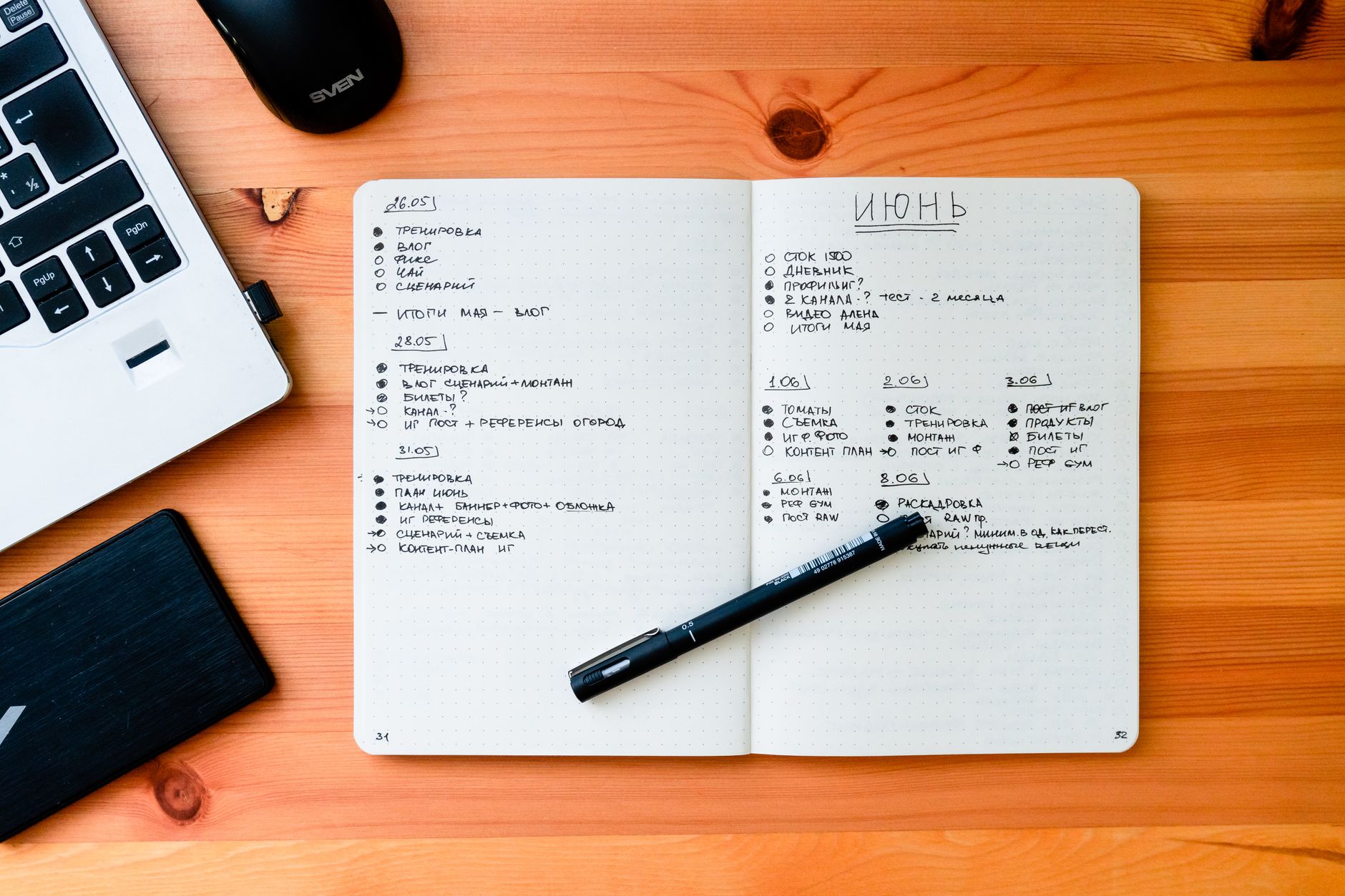
1. Paper and Pen (The Classic Method)
Advantages: It’s tangible, distraction-free, and forces you to be concise. How to use it:
- Use a notebook dedicated only to your master list and the 6 daily tasks.
- Divide the page into two columns: one for the master list (all tasks) and one for the 6 tasks of the day.
- Cross out completed tasks to get a visual sense of progress.
- At the end of the day, tear out the page and start fresh the next day.
Disadvantages: It’s not practical if you work in a team or need to access your tasks from multiple devices. It’s also hard to search for old tasks or attach files.
2. Note-Taking Apps (Like Google Keep, Apple Notes, or Notion)
Advantages: They’re accessible from any device and allow you to attach files or links. How to use them:
- Create a note titled "Master List" and another called "6 Tasks for [date]".
- Use tags or colors to differentiate jobs (e.g., red for Client A, blue for Client B).
- Manually order tasks by dragging them.
- Archive notes from previous days to keep them, but keep only the current day’s note visible.
Disadvantages: They lack advanced prioritization or reminder features and can become chaotic if not organized well.
3. Task Management Apps (Like Todoist, TickTick, or Microsoft To Do)
Advantages: They’re designed for task management, with features like reminders, due dates, and priorities. How to use them:
- Create a project or list for each job (e.g., "Client A," "Personal Project").
- Add all tasks to their respective projects, with due dates if they have them.
- Each day, review the master list and select the 6 most important tasks. Use the "priority" or "star" feature to mark them.
- Work on one task at a time, using the "today" or "upcoming" view to avoid distractions.
Disadvantages: Some apps can be too complex for the Ivy Lee method, with features you don’t need that can distract you.
4. Apps Designed for Multiple Jobs (Like Foco)
If you manage multiple jobs at once, an app designed for this scenario can simplify the Ivy Lee method. For example, Foco lets you:
- Create an independent container for each job (e.g., "Client A," "Personal Project"), each with its own color. This way, when you see your tasks, you instantly know which job they belong to.
- Use Panorama mode to see all tasks from all jobs in one list, ideal for your master list. Then, in Focus mode, filter and see only the tasks from one specific job, helping you concentrate on one context at a time.
- Organize your 6 daily tasks in the List view, where you can group them by date (today, this week) and drag them to order by priority. The Kanban view is also useful for moving tasks between columns like "To Do," "Doing," and "Done."
- Add execution dates (when you’ll work on the task) and due dates (the deadline), which helps you prioritize more effectively. For example, a task with an execution date today but a due date next week can wait if something more urgent comes up.
- Use voice capture to quickly add tasks to your master list without breaking your workflow. If you dictate "Review Client B’s design by Thursday, important," Foco automatically detects the date, priority, and creates the task with that data.
Foco isn’t the only option, but its design is tailored to avoid visual overload when you have many fronts open, which is key to successfully applying the Ivy Lee method. If you try the method on paper or with another app and feel overwhelmed by managing multiple jobs, tools like this can help you stay focused without losing the system’s simplicity.
Prioritizing isn’t about choosing what to do, but deciding what not to do today. The Ivy Lee method forces you to face that truth every day.
Conclusion: Is the Ivy Lee Method Worth It for Multiple Jobs?
The Ivy Lee method isn’t a magic solution, but it’s one of the most effective prioritization techniques for avoiding overload when managing multiple jobs. Its greatest virtue is simplicity: it forces you to make tough decisions (what deserves to be in the six tasks?) and execute without distractions. It doesn’t eliminate stress entirely—there will always be chaotic days—but it gives you a framework to move forward without drowning in an endless to-do list.
If you decide to try it, start with these steps:
- Today, create a master list with all your tasks, without filtering. Include everything, from the most important to the most trivial.
- Tomorrow, choose only six tasks following the criteria of deadlines, impact, and dependencies. Order the list and focus on the first task until it’s done.
- At the end of the day, review what worked and what didn’t. Adjust the method to your reality: maybe you need 7 tasks instead of 6, or maybe you need to break large tasks into subtasks.
- Repeat the process for a week. If you notice you’re making more progress and feeling less overwhelmed, stick with it. If not, adjust or try another technique.
The Ivy Lee method isn’t for everyone. If your job requires constant multitasking (e.g., customer service) or if your tasks are too unpredictable (e.g., medical emergencies), it might not be the best option. But if you spend more time deciding what to do than doing it, this method could be the change you need to regain control of your day.
Try Foco
Every task from every job in one place. Free to start.